
At 7:41 on Thursday evening, Eli Rivera was washing a coffee mug with considerably more intensity than the mug’s behavior seemed to justify.
The mug had done nothing wrong. It had contained coffee that morning, sat peacefully beside the sink for most of the day, and was now being scrubbed as though investigators might later test it for evidence.
Naomi noticed.
She was sitting at the kitchen island with her laptop open, answering one final email before officially declaring the workday dead. She watched her husband rinse the mug, inspect it, and then begin cleaning a section that had already been clean for some time.
“You okay?”
“Yep.”
Naomi looked at him.
Eli continued washing.
“Everything good?”
“I’m fine.”
“Okay.”
She returned to her laptop.
Eli stared at the back of her head in disbelief. Five years of marriage, and apparently this woman knew nothing about him.
He placed the mug in the drying rack with enough care to communicate several emotions, none of which Naomi appeared to receive. This was especially disappointing because Eli believed he had been extremely clear. He had said fine in the unmistakable tone that meant the precise opposite of fine. There had been a slight pause before the word. He had not made full eye contact. His shoulders were approximately twelve percent stiffer than usual.
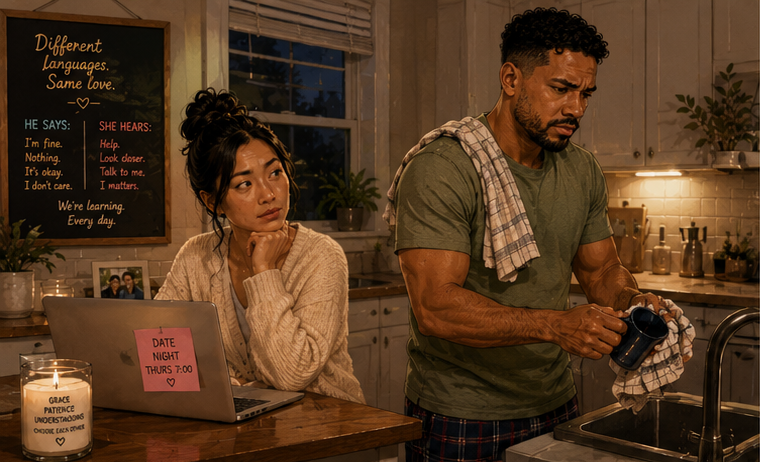
The evidence was everywhere.
Naomi typed another sentence.
Eli opened a cabinet he did not need to open, looked inside, and closed it again.
Nothing.
He opened the refrigerator, also for no identifiable reason.
Naomi glanced up.
“You hungry?”
“No.”
“Okay.”
There it was again: Okay.
Eli closed the refrigerator and considered, for the first time in five years, how aggressive a perfectly calm two-syllable word could feel.
Naomi Park Rivera was, under ordinary circumstances, an observant woman. She noticed when Eli was getting a cold two days before he admitted he felt sick. She could usually tell from the way he entered a room whether his mother had called with family news. She knew that when he said, “I don’t care where we eat,” he actually cared quite a bit but had not yet gathered enough courage to reject her first two suggestions.
Naomi noticed things.
Which was why Eli found tonight’s failure particularly troubling.
He walked into the living room and sat on the far end of the couch. Naomi finished her email, closed the laptop, and joined him.
She looked at the space between them, then at Eli.
“Are you sure you’re okay?”
“I told you I’m fine.”
“All right.”
She picked up the remote.
Eli looked at her.
Naomi turned on the television.
Apparently, their marriage was now being held together by procedural negligence.
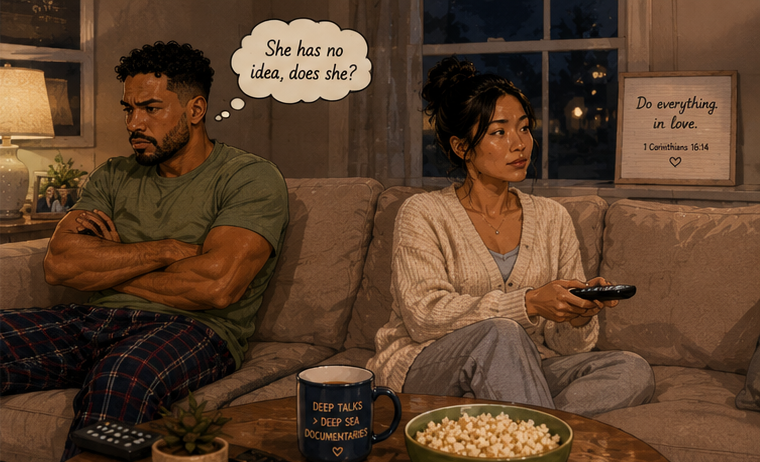
Eli Rivera had grown up in a Puerto Rican-American family where feelings were rarely absent, although they were not always delivered in neat little packages.
His mother, Marisol, could communicate disappointment simply by saying his full name with the precision of someone reading from a legal document. His father, Rafael, believed most difficult conversations improved after coffee. His grandmother Carmen believed no human emotion had ever successfully concealed itself from her and treated privacy as a theory younger generations had developed without sufficient evidence.
Eli loved them all.
He had also inherited what Naomi called the Rivera face, which appeared whenever he was hurt but had not yet decided whether he wanted to admit it. His mouth tightened slightly, his eyebrows lowered, and he became unusually interested in household tasks that required no conversation.
According to Eli, the face was subtle.
According to everyone else, he looked like a man trying to emotionally process a parking ticket.
Naomi came from a Korean-American family whose emotional vocabulary had developed differently but was no less sophisticated. Her mother, Sun-hee, rarely asked, “Are you stressed?” She simply appeared at the house carrying food.
If Naomi had a difficult week, containers began arriving: soup, rice, fruit already cut, side dishes in quantities suggesting a small regional emergency.
During their first year of marriage, Eli had once opened the refrigerator after Naomi casually mentioned being tired to her mother and discovered enough food to survive a moderate winter.
“This is how your mom says she loves us?” he asked.
Naomi nodded.
Eli surveyed the bulgogi, japchae, soup, kimchi, and two containers whose contents he had not yet been cleared to identify.
“I feel extremely loved.”
Over the years, they had learned each other’s families and languages of care. Naomi knew that if Marisol sent home arroz con gandules “just because,” she had almost certainly made extra specifically for Eli. Eli knew that if Sun-hee said, “Take jacket,” debating the weather would merely postpone the inevitable jacket.
They had learned a great deal about each other.
Which, in Eli’s opinion, made the current situation even harder to explain.
He should not have to explain it.
Naomi should know.
This conviction remained comfortably intact until she turned on a documentary about deep-sea exploration.
Eli stared at the television.
They both hated documentaries about the ocean. Naomi knew this, and Eli knew Naomi knew this, which meant she had now selected a program neither of them wanted to watch while her husband was visibly suffering beside her.
The marriage had taken a dark turn.
“What are we watching?” he asked.
Naomi looked at the screen.
“I don’t know. You weren’t saying anything.”
Eli nodded slowly. “Right.”
Naomi turned toward him.
“What?”
“Nothing.”
She stared.
He stared back.
Naomi muted the television.
“Eli.”
“What?”
“You are doing something.”
“I’m sitting.”
“You are sitting at me.”
Eli frowned. “I don’t know what that means.”
“Neither do I, but you’re doing it.”
Despite himself, Eli almost smiled.
Naomi saw it.
“There. You’re alive.”
“I’ve been alive.”
“Debatable.”
She placed the remote on the coffee table.
“Talk to me.”
“About what?”
Naomi leaned back. “Excellent question. If only someone in this room had information.”
Eli looked away.
She waited.
When nothing came, Naomi sighed. “All right. I’m going to ask one more time. Are you upset with me?”
Eli could have said yes. The option was available, clear, and completely free of charge.
He chose poorly.
“I’m fine.”
Naomi stared at him for several seconds and then nodded.
“Okay.”
Eli’s head turned immediately.
“See?”
Naomi frowned. “See what?”
“That.”
“What?”
“The ‘okay.’”
“You said you were fine.”
“Exactly.”
She blinked.
There are moments in marriage when two intelligent adults suddenly realize they have arrived at a destination neither of them can explain. Naomi looked genuinely confused. Eli looked genuinely disappointed in her confusion.
Finally she said, “I need more information.”
Eli sat forward.
“Naomi, everybody knows FINE means Feelings Inside Not Expressed.”
There was a pause.
Naomi stared at him.
“Everybody?”
“Yes.”
“Everybody where?”
“Everybody.”
“Which governing body approved this?”
Eli sighed. “Marriage.”
“Marriage did not send me that memo.”
“It was implied.”
“So now I’m being graded on acronyms I was never issued?”
Eli folded his arms.
“I just feel like after five years—”
“No.” Naomi held up one hand. “Absolutely not. You cannot invent emotional NATO and then blame me for not knowing the codes.”
Eli stared at her while Naomi’s mouth twitched.
His did too.
For one dangerous moment, the argument was at risk of becoming funny.
Eli refused to let it escape that easily.
The actual problem had begun at 3:18 that afternoon.
Naomi’s sister Hannah had texted their family group chat about Saturday. Their parents were planning to come over, Hannah and her husband would bring the kids, and Naomi had replied that everyone could gather at their house because they had more room and her parents had been wanting to see the new patio furniture.
None of this was inherently unreasonable.
It was, however, the third Saturday in a row that Eli’s plans had shifted because something had come up with Naomi’s family.
The first weekend had been a birthday dinner. The second had turned into an unexpectedly large Costco trip followed by lunch because Sun-hee needed help carrying “a few things,” which turned out to be enough groceries to provision a cruise ship.
This Saturday, Eli had planned to spend the afternoon with his cousin Mateo, who was in town for only a few days.
He had mentioned it.
At least Eli was fairly certain he had mentioned it.
This detail would later become inconvenient.
At 3:18, Naomi texted:
My parents + Hannah’s family are coming Saturday. I told them our place is easier. ❤️
Eli looked at the message and felt something small but sharp. It was not rage or even major anger, just that familiar little ache of feeling as though his plans had been moved to the edge of the table without anybody noticing they were there.
He typed:
Okay.
Then deleted it.
He typed:
I thought I mentioned Mateo.
Deleted that too.
Finally, he sent:
Sounds good.
This was, objectively, not a useful contribution to the communication process.
At 3:20, Naomi replied:
Thank you ❤️
Eli stared at the heart and somehow became more annoyed.
The heart had done nothing wrong either.
It was becoming a difficult day for innocent symbols.
By the time Naomi came home, Eli had convinced himself she should notice something was wrong without him having to say it. At first, this seemed perfectly reasonable.
Then she noticed.
She asked.
And Eli denied it.
Twice.
Now he was sitting on the couch explaining emotional acronyms.
Things had gotten away from him.
Naomi watched her husband carefully.
“Okay,” she said. “Let me try this differently. You’re not fine.”
Eli said nothing.
“That wasn’t a question.”
“Fine.”
Naomi narrowed her eyes.
“Poor word choice.”
He almost laughed.
She moved a little closer.
“Is this about Saturday?”
Eli looked at her.
Naomi exhaled.
“It is.”
“You knew?”
“I suspected.”
His eyebrows rose.
“Then why didn’t you say anything?”
Naomi’s eyes widened.
“I did.”
“No, you asked if I was okay.”
“Three times.”
“But you didn’t ask about Saturday.”
“Eli.”
“What?”
“How many questions am I supposed to use before you participate?”
He looked away.
Naomi folded her legs beneath herself.
“I knew something was off. I did not know what. So I asked you.”
“You know me.”
“Yes.”
“You know when I’m upset.”
“Also yes.”
“Then—”
“Then what?”
Eli hesitated. The problem with demanding that someone understand you without explanation is that eventually they may ask you to explain the demand.
He did not have a particularly elegant answer.
“I just thought you’d know.”
Naomi’s expression softened slightly.
“Know what?”
“That Saturday bothered me.”
“Why?”
Eli frowned.
“You changed our plans.”
Naomi looked confused.
“Our plans?”
“Yes.”
“What plans?”
He stared at her.
Now they had reached the second problem.
“Mateo.”
Her face changed.
“Oh.”
“Yeah.”
“You’re seeing Mateo Saturday?”
“I was supposed to.”
“I didn’t remember that.”
“I told you.”
“When?”
“Earlier this week.”
Naomi thought for a moment.
“I genuinely don’t remember.”
“I know.”
There was more weight in his voice than the sentence required, and Naomi caught it.
She studied him.
“This isn’t only about Saturday, is it?”
Eli did not answer immediately, which was at least different from saying fine. Progress had to start somewhere.
Finally he said, “I feel like lately I tell you things and they don’t stick.”
Naomi became still.
He continued more carefully. “I know you’ve had a lot going on. Work has been crazy. Your parents have needed more help. Hannah’s kids have had all their stuff. I get it.”
“But?”
Eli rubbed his hands together.
“But sometimes I feel like I’m standing just outside everything.”
The room changed.
Naomi’s face softened completely.
Eli looked down.
“I know that sounds dramatic.”
“It doesn’t.”
“I don’t need to be the center of everything.”
“I know.”
“I just…” He struggled for the sentence and hated that it was harder to say than I’m fine. “I wanted you to notice.”
Naomi did not interrupt.
“I wanted you to remember Mateo. I wanted you to know I’d been looking forward to it. And when you didn’t, I guess it felt like maybe what I was doing wasn’t that important.”
There it was—not really Saturday, not Hannah, not even Mateo, but something smaller and more vulnerable underneath all of it.
I want to matter enough to be remembered.
Naomi moved closer.
“You do.”
“I know.”
“Do you?”
Eli looked at her.
She reached for his hand.
“I’m sorry I forgot.”
He nodded.
“I should have remembered, and I should have checked with you before volunteering our house.”
“Thank you.”
Naomi squeezed his fingers.
“But.”
Eli closed his eyes.
“There it is.”
“Yes, there is absolutely a but.”
He looked at her.
“I want to know when I hurt you.”
“I know.”
“No. Listen.” Her voice softened. “I really do. I want to know you well enough to notice things. I want to remember what matters to you. I want to be better at that.”
Eli nodded.
“But I cannot know what you refuse to let me know.”
He looked away.
Naomi continued. “You were upset. I noticed. I asked you.”
“I know.”
“You told me you were fine.”
“I know.”
“Repeatedly.”
“We’re moving away from the apology now.”
Naomi smiled.
“I’m serious.”
“So am I.”
She leaned toward him.
“I want to know you, Eli. But you have to let me know you.”
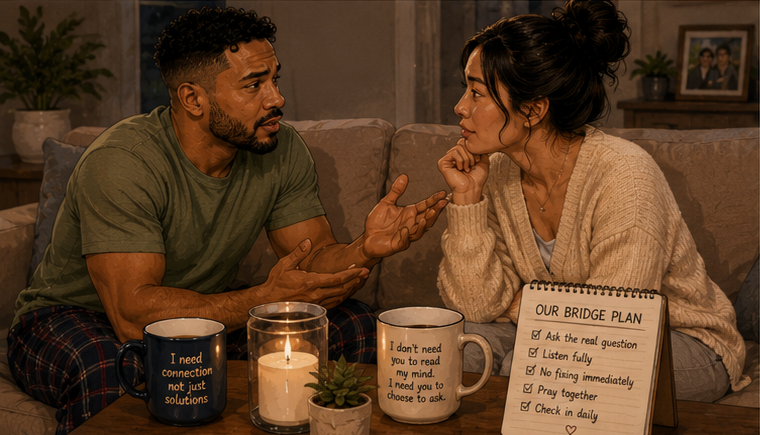
That landed harder than he expected.
He sat quietly for a moment before saying, “I don’t want to have to spell everything out.”
“I don’t think you should have to spell everything out.”
“Thank you.”
“But you did spell something out.”
Eli frowned.
Naomi looked directly at him.
“F-I-N-E.”
He stared.
“And somehow I was supposed to translate that into the exact opposite.”
Eli looked away.
“When you say it like that, it sounds unreasonable.”
“That is because I said it accurately.”
He laughed despite himself.
Naomi smiled.
The argument had officially lost control of itself.
A few minutes later, Eli’s phone began ringing.
He looked down.
Abuela Carmen — FaceTime
Naomi saw the name and immediately laughed.
“No.”
“What?”
“Do not answer that.”
“Why?”
“Because your grandmother has sonar.”
“She probably just wants to say hi.”
Naomi gave him a look.
“You currently have the Rivera face.”
“I do not.”
“You absolutely do.”
Eli touched his face as though checking whether an unauthorized expression had appeared there.
Naomi folded her arms.
“If you answer that call, she will know.”
“She lives forty minutes away.”
“She would know from Puerto Rico.”
Eli shook his head.
“You have built this woman into a supernatural entity.”
The phone kept ringing.
Naomi smiled.
“Answer it.”
Eli became immediately suspicious.
“You want me to answer now?”
“Very much.”
He narrowed his eyes and accepted the call.
Carmen’s face filled the screen.
“¡Mi amor!”
“Hola, Abuela.”
“There you are.”
“There I am.”
Naomi leaned into frame.
“Hi, Abuela.”
Carmen brightened.
“Naomi! Beautiful girl. How are you?”
“I’m good.”
“Good, good.”
Then Carmen looked back at Eli.
Her eyes narrowed.
“What happened?”
Naomi turned away immediately because she was already laughing.
Eli stared at the screen.
“Nothing happened.”
Carmen leaned closer to her camera.
“Do not give me that face.”
“What face?”
“The Rivera face.”
Naomi made a small choking sound.
Eli glared at her.
Carmen continued. “Your grandfather had that face. Your father has that face. All you Rivera men look constipated when your feelings are hurt.”
Naomi folded forward.
Eli closed his eyes.
“Abuela.”
“What?”
“Nothing is wrong.”
“Liar.”
By now Naomi had buried her face in a throw pillow.
Eli looked at his grandmother.
“You called just to insult me?”
“I called because your mother said you haven’t called me all week.”
“I called you Sunday.”
“It is Thursday.”
“That is four days.”
“Exactly.”
Eli decided not to enter this separate conflict.
Carmen tilted her head.
“You and Naomi fighting?”
“No.”
Naomi sat up.
“We’re not fighting anymore.”
Eli looked at her.
Carmen’s eyebrows rose.
“Ah.”
“Naomi.”
“What? She asked.”
Carmen leaned toward the screen with renewed interest.
“What did he do?”
“Why am I automatically the one who did something?”
Both women looked at him.
Eli sighed.
“Never mind.”
Carmen pointed through the phone.
“You apologize.”
“I already did.”
Naomi gently corrected him.
“I apologized.”
Carmen looked delighted.
“Oh, so she did something.”
Eli opened his mouth, but Naomi cut in.
“We both did.”
Carmen nodded approvingly.
“Good. That is marriage.”
There was a brief silence before Eli smiled slightly.
“Abuela, what does FINE mean?”
Naomi’s head snapped toward him.
“Oh no.”
Carmen did not hesitate.
“It means somebody is upset and being dramatic.”
Naomi slapped the couch.
“Thank you!”
Eli stared at the screen.
“Whose side are you on?”
Carmen looked genuinely puzzled.
“The side with eyes.”
Naomi lost whatever composure she had left.
Eli leaned his head against the couch.
“This family is hostile.”
Carmen smiled.
“You love us.”
“I do.”
“Good. Call your mother.”
“I talked to her yesterday.”
“Call her again.”
“Why?”
“Because she is your mother.”
There was no legal response available.
“Yes, Abuela.”
“Good. Give Naomi a kiss.”
“Abuela.”
“And stop making that face.”
The call ended.
Naomi sat beside him, still laughing.
Eli stared at the blank screen.
“So apparently there is a mind reader in the family.”
Naomi wiped beneath one eye.
“No. Your grandmother just has premium access.”
He looked at her.
She smiled.
He shook his head, but he was smiling too.
The Saturday problem still needed solving, because this was the inconvenient thing about finally communicating: eventually, you had to address the actual logistics.
Naomi picked up her phone.
“I can text Hannah and tell them we can’t host.”
Eli shook his head.
“You don’t have to cancel everything.”
“But you have plans with Mateo.”
“I do.”
“So go.”
He looked at her.
“You’re okay hosting everyone?”
“Of course.”
“You sure?”
Naomi nodded. “My family is coming to see us, not inspect your attendance record.”
“Your mother may ask where I am.”
“I’ll tell her.”
“What will you say?”
“That my husband told me something important and, in a shocking turn of events, I listened.”
Eli smiled.
“Maybe don’t phrase it like that.”
“I’ll workshop it.”
He squeezed her hand.
“Thank you.”
Naomi leaned against him.
“For the record, I really am sorry I forgot.”
“I know.”
“I’ve been stretched thin.”
“I know that too.”
“And I don’t want you feeling like you’re outside everything.”
Eli looked down at their hands.
“I probably should have just said that.”
“That would have saved us the mug.”
He frowned.
“What mug?”
“The one you were interrogating in the kitchen.”
“I was washing it.”
“You were trying to make it confess.”
Eli laughed.
“It had coffee stains.”
“It feared for its life.”
They sat quietly for a moment before Naomi looked up at him.
“Can we make a deal?”
“What?”
“If I ask whether you’re okay, you are allowed to say, ‘I’m upset, but I’m not ready to talk yet.’”
Eli nodded.
“Fair.”
“Or, ‘Yes, something bothered me. Give me a minute.’”
“Okay.”
“Or even, ‘No, I’m not fine.’”
He frowned.
“That feels very exposed.”
Naomi laughed.
“I know.”
“And what are you going to work on?”
“Noticing without assuming that noticing is enough.”
He considered that.
“Okay.”
“And remembering your plans.”
“Yes.”
“And checking with you before I volunteer our house.”
“Strongly yes.”
Naomi smiled.
Eli leaned over and kissed her forehead.
“There. Communication.”
“Beautiful.”
“We’re really good at marriage.”
Naomi looked at him.
“Let’s not get reckless.”
The next evening, Naomi came home carrying two grocery bags while Eli was in the kitchen preparing dinner. She placed the bags on the counter with a tired exhale and began putting things away.
Eli looked over.
“You okay?”
Naomi opened the refrigerator.
“I’m fine.”
Eli froze.
She continued unloading groceries as though nothing unusual had happened.
He slowly put down the wooden spoon.
“No.”
Naomi looked at him.
“No what?”
“You know what.”
“I said I’m fine.”
Eli pointed at her.
“Feelings Inside Not Expressed.”
Naomi stared.
“You cannot use my own marriage against me.”
“You mocked the system. You did not repeal it.”
She tried to hold her expression.
Failed.
Eli smiled triumphantly.
“So what’s wrong?”
“Nothing.”
“Naomi.”
She laughed.
“I’m kidding.”
“You are playing dangerous games.”
“I had a long day. That’s all.”
“Do you want to talk about it?”
“Maybe after dinner.”
Eli nodded.
“Okay.”
Naomi looked at him.
That simple.
No guessing, no emotional NATO, no forensic analysis of how aggressively someone placed a grocery bag on the counter. Just a question, an answer, and the reasonable possibility that two people who loved each other could occasionally use words.

Then Naomi noticed what was on the stove.
“Is that your mother’s arroz con gandules?”
“My mother sent it over.”
“She knew we were having a hard week?”
Eli shrugged.
“I mentioned work was crazy.”
Naomi smiled.
“Your family sends rice. Mine sends soup.”
“Love is efficient.”
She walked over and wrapped her arms around him from behind. Eli covered her hands with his, and for a moment the kitchen was quiet.
Then Naomi said, “By the way, your mug is still traumatized.”
Eli looked toward the drying rack.
“I apologized.”
“Did it accept?”
“It needs space.”
Naomi laughed into his back.
And that was probably as close to mind reading as either of them needed to get.
Behind this episode
Eli and Naomi are learning that being deeply known does not mean being completely readable.
Naomi can become more attentive to the things that matter to Eli, and Eli can tell her when something hurts instead of denying it and then waiting for her to correctly decode the denial. Wanting to be noticed is deeply human. So is wanting a fair chance to respond to what your spouse actually needs.
Go deeper: Your Spouse Is Not a Mind Reader. Unfortunately.
A tiny signal. No comments, no profile, no public identity.