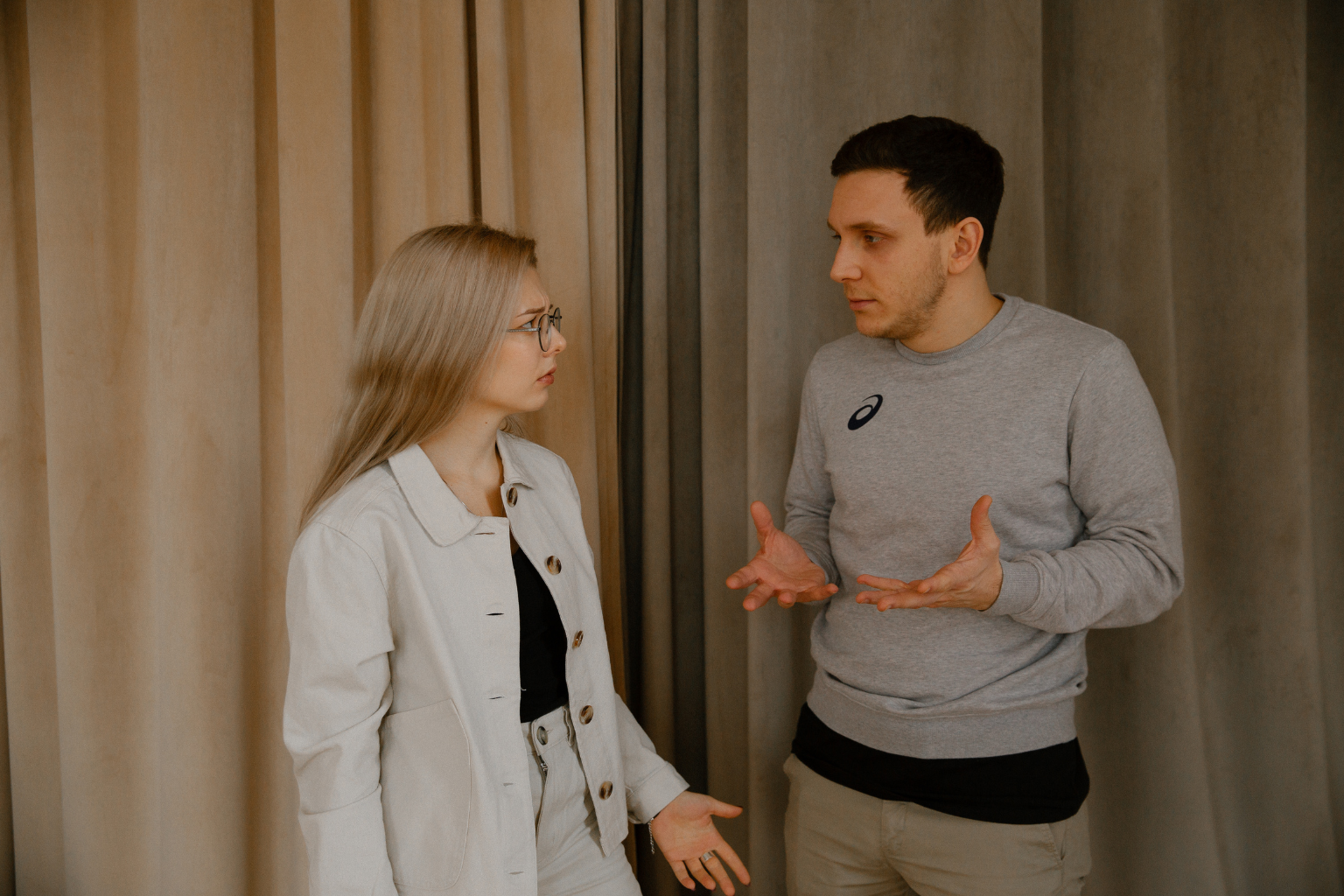
It is 8:46 p.m., and something is wrong.
Not emergency wrong. Nobody needs an ambulance. The house is still standing. The children have finally stopped requesting things. But you are loading the dishwasher with a level of intensity normally reserved for competitive sports, and your spouse has correctly concluded that the plates are not the real issue.
“Everything okay?” they ask.
You keep loading. “I’m fine.”
Now, this is an important moment because, in your head, I’m fine means something very specific. It means, I am clearly not fine, and because you love me and have known me for all these years, I would now like you to recognize this, remember the thing that happened earlier, identify why it bothered me, understand the deeper emotional meaning behind it, and respond appropriately.
Your spouse, meanwhile, has received the following information: you are fine.
So they say, “Okay.”
And somehow, against all odds, this is the worst possible answer.
You close the dishwasher a little harder than necessary, because apparently the marriage is now in danger after one person failed an exam they did not know they were taking.
Welcome to one of the stranger expectations we sometimes bring into long-term relationships: the belief that being deeply known should eventually eliminate the need to explain ourselves.
We rarely say it that plainly. Usually it sounds more like, “I shouldn’t have to tell you,” or “You know me better than that,” or the timeless classic, “If you don’t know what you did, I’m not going to tell you.”
The logic is understandable. We want our spouse to know us. In fact, being known is one of the beautiful parts of marriage. After enough years together, your spouse may know which look means you are ready to leave the party, which restaurant you are about to suggest before you say it, and exactly how dangerous it is to speak to you during the final thirty seconds of a close game.
Couples develop a language. They learn each other’s rhythms. Sometimes your spouse really can look at your face and say, “Something’s wrong,” before you have said a word.
And that feels good.
The trouble begins when we quietly turn that beautiful familiarity into a requirement for telepathy.
Because your spouse is not a mind reader.
Unfortunately.
Being known is not the same thing as being completely readable
There is something deeply satisfying about being anticipated.
Your spouse brings home your favorite snack without asking. They can tell you need a minute before talking. They know which family gathering has probably exhausted you. They hear your voice on the phone and immediately ask, “What happened?”
Those moments can feel like evidence of being deeply known because, in a real sense, they are.
Researchers use the term empathic accuracy to describe how well one person can infer another person’s thoughts and feelings. A meta-analysis of studies involving romantic partners found a small but meaningful positive association between greater empathic accuracy and relationship satisfaction.
So yes, being able to read one another matters.
The problem is not wanting your spouse to become better at understanding you. They should. Over time, married people ought to learn each other more deeply. What overwhelms you should become more familiar to them. What encourages you should become easier to recognize. They should begin noticing patterns, remembering what matters, and getting better at interpreting the little signals that accompany years of shared life.
But there is an enormous difference between appreciating when your spouse reads you well and deciding that love should make explanation unnecessary.
Researchers Courtney Wright and Michael Roloff have studied something they call mind-reading expectations: the belief that a romantic partner should recognize our feelings or understand why we are upset without us explicitly saying so. Their research found that stronger mind-reading expectations were associated with more negative responses when partners failed to recognize an unstated relational problem.
In ordinary language, science has confirmed the existence of you should know why I’m mad.
Which is reassuring, because married couples appear to have been gathering field data on this phenomenon for centuries.
The difficulty with mind-reading expectations is that they can create a test your spouse cannot reliably pass. If they correctly guess what you need, they have demonstrated love. If they guess incorrectly, their failure becomes proof that they do not know you well enough.
Meanwhile, you possess the answer key and have declined to distribute it.
That is a difficult educational environment.
Your spouse knows you well. You still have information they don’t.
Marriage creates familiarity, but it does not merge two brains.
That sounds obvious until you consider how often we forget it.
You know that the comment your spouse made this morning bothered you more than you initially realized. You know you have been worrying about an upcoming conversation at work for three days. You know you felt disappointed when nobody acknowledged something you worked hard on. You know you are so tired that something that would normally be mildly irritating currently feels like a personal attack from the universe.
Your spouse may know none of that.
They may have clues. They may notice you are quiet. They may correctly sense that something is off. But they are still interpreting your behavior from the outside while you are experiencing your thoughts from the inside.
That difference is enormous.
Researchers studying empathic accuracy have found that people use a combination of cues from their partners and their own accumulated knowledge to infer what the other person is thinking or feeling. That ability can become remarkably good in a close relationship, but it remains an inference. Your spouse has access to your facial expressions, tone, history, behavior, and whatever information you choose to share.
They do not have subtitles.
This becomes particularly important when we punish our spouse for failing to know something that feels obvious to us only because we have had front-row seats to our own thoughts.
You may think, I can’t believe you didn’t realize I wanted you to come with me. But did you actually say that? Perhaps you assumed they would remember that you hate attending those events alone. Meanwhile, they may remember the three times you recently told them you wanted to handle something independently and were trying to respect your space.
Human beings are annoyingly complicated that way.
The person who has known you for twenty years may understand you remarkably well. They are still working from the outside.
Hints are always louder to the person giving them
One reason mind-reading expectations survive is that we frequently believe we did communicate.
We hinted.
Strongly.
Perhaps three weeks ago you mentioned that the two of you had not been out together in a while. A few days later, you sent your spouse a video of a new restaurant. Then your friend and her husband went out Friday night, and you casually observed that “apparently some people still date their spouses.”
At this point, you feel that your intentions could not possibly be clearer.
Your spouse has concluded that you enjoy restaurant videos and have complicated feelings about the Parkers.
This is one of communication’s great injustices: hints feel significantly louder from the inside.
We know all the context surrounding our own words. We know what we hope the other person will notice, which means the breadcrumbs seem enormous to us. When our spouse walks right past them, it can feel deliberate.
Sometimes hints are perfectly fine. Flirting would become painfully bureaucratic if every romantic intention needed to be submitted as a clearly worded request.
But when something genuinely matters to you, there comes a point where hinting stops being charming and becomes a scavenger hunt.
“I’d really love for us to go out together this weekend” gives your spouse a fighting chance.
“I just think it’s interesting that the Parkers somehow make time for each other” gives them several different problems to solve, including why the Parkers are suddenly under investigation.
Directness does not have to be cold. In many situations, directness is actually generous because it gives the person you love the information they need to love you well.
“Your spouse isn’t a mind reader” can become lazy advice too
There is an important distinction here because this idea can be taken too far.
Imagine one spouse standing beside an overflowing trash can and saying, “I really wish you would help more around here.”
The other responds, “Well, you never specifically asked me to take that bag out.”
That is not a victory for healthy communication.
That is an adult standing beside garbage.
Shared life creates some reasonable expectations of awareness. If dishes are piled in the sink, children need dinner, laundry has been sitting in the washer since the previous presidential administration, and your spouse is visibly juggling six things at once, “Well, you didn’t ask” eventually stops being an explanation.
Marriage should involve learning to notice.
There is a difference between expecting your spouse to infer an unspoken internal need and expecting a capable adult to participate thoughtfully in a shared visible reality.
“I wish you had known I needed reassurance after that meeting even though I never told you I was nervous” is one kind of expectation.
“I wish I did not have to issue a personal invitation every time the dishwasher needs unloading” is another.
The answer to mind-reading expectations is not deliberate obliviousness.
You should learn your spouse. You should notice patterns. You should remember things they have told you before. You should gradually become better at recognizing what overwhelms them, encourages them, delights them, or makes them feel cared for.
That is part of intimacy.
Researchers who study perceived partner responsiveness consistently find that people tend to feel closer and more satisfied when they experience their partner as someone who understands, values, and cares about them.
But responsiveness is not clairvoyance.
A healthy marriage probably contains both: I know you well enough to notice, and I trust you enough to tell you.
Those ideas belong together.
Sometimes “I shouldn’t have to ask” is really about wanting to be noticed
There is another reason we resist asking plainly: sometimes the thing we want is not just the action itself.
We want the action to be voluntary.
You do not merely want flowers. You want your spouse to think of bringing you flowers. You do not simply want them to ask about the meeting. You want them to remember that the meeting mattered. You do not merely want twenty quiet minutes. You want them to look at you, recognize that you are barely functioning, and say, “I’ve got the kids. Go sit down.”
That is different.
And it is not unreasonable to want it.
There is something especially meaningful about being cared for without having to organize the care yourself. When someone anticipates a need, the gesture communicates more than the action. It says, I was paying attention to you.
So when someone says, “It doesn’t mean the same thing if I have to ask,” there may be a real grief underneath that sentence.
Perhaps the missing cup of coffee is not actually the issue. Perhaps the deeper wound is feeling unnoticed.
That deserves a more honest conversation than pretending the need itself does not exist.
Instead of shutting down with, “Forget it. I shouldn’t have to tell you,” you might eventually say, “I know I could have asked for help. I think what hurt was that I really wanted you to notice how overwhelmed I was.”
Now your spouse has useful information.
They may even respond, “I honestly didn’t realize you were overwhelmed.”
This may be frustrating because, from your perspective, you were carrying a laundry basket, answering a work call, making dinner, and using one foot to prevent a child from entering the pantry. You thought you were essentially broadcasting on all available frequencies.
But at least now you are discussing the actual wound rather than debating whether sufficiently loving spouses eventually develop supernatural perception.
Asking clearly does not make the care fake
This may be one of the hardest parts.
If you tell your spouse exactly what you need and then they do it, does the gesture somehow count less?
I understand why it can feel that way. A surprise birthday party you planned yourself does lose a little of the magic.
But most marital care is not a surprise party.
If you tell your spouse, “I don’t need advice right now; I just need you to listen,” and they put down what they are doing and give you their full attention, that care is not counterfeit simply because you gave them direction.
If you say, “I’m stretched really thin tonight. Could you handle bedtime?” and they immediately take it over, the fact that they did not independently calculate your precise exhaustion level at 6:17 p.m. does not erase the kindness.
If you tell them, “Birthdays matter more to me than I think you realize,” and the following year they make a genuine effort to celebrate you, that does not count less.
It may count more because they listened.
There is a strange thing we sometimes do in marriage: we refuse to tell someone how to love us and then become disappointed that they loved us incorrectly.
Meanwhile, there is a decent chance our spouse is doing exactly the same thing in another area.
Both people end up carrying secret instruction manuals while feeling offended that the other person has somehow failed to read them.
Perhaps exchanging a few pages would help.
Clear requests are kinder than disguised accusations
Telling your spouse what you need also works much better when the request is actually a request rather than evidence in a criminal proceeding.
Consider the difference between, “You never help me when I’m stressed,” and, “Today got away from me. Could you take care of dinner tonight?”
The second version gives your spouse somewhere to go.
That sounds simple, but direct requests can feel vulnerable because they create the possibility of hearing no. Complaints sometimes feel safer because we get to establish that the other person is already wrong before asking them for anything.
The problem is that complaints often drag both people backward into defending the past before either person can address the present.
Imagine saying, “You never spend time with me.” Your spouse immediately protests because you watched a movie together Sunday. You point out that they fell asleep. They insist they were awake for most of it. You remind them they were snoring. They explain they were “resting their eyes aggressively.”
Ten minutes later, you are litigating sleep behavior rather than discussing the fact that one person feels lonely.
A clearer request—“I miss you. Can we spend some time together tonight without our phones?”—expresses the same underlying longing while giving the relationship a much better chance of moving toward it.
We also get into trouble when we read our spouse’s mind
There is another version of this problem that deserves equal attention.
Sometimes we are not expecting our spouse to read our mind.
We are confidently reading theirs.
“I know exactly why you did that.”
“You clearly don’t care.”
“You’re only saying that because you’re mad.”
“You didn’t text because I wasn’t important enough.”
“You’re quiet because you’re annoyed with me.”
Maybe.
Or perhaps your spouse is quiet because they are thinking about an email from work, trying to remember where they put their wallet, wondering whether the chicken in the refrigerator is still safe, and replaying something embarrassing they said in 2014.
Human brains are busy places.
Assuming motives can become particularly dangerous because we start reacting emotionally to a story we created before checking whether the story is true.
Suppose your spouse walks past without saying much. You think, They’re still angry with me, so you become cold. Your spouse notices the coldness, has no idea where it came from, and begins pulling back. You see them pulling back and think, I knew it. They are mad.
Congratulations.
We have now manufactured evidence for the original theory.
Curiosity interrupts that cycle.
“You seem quiet. Everything okay?”
That simple question leaves room for reality to surprise you. It does not accuse, diagnose, or conclude. You are giving the person whose mind you were about to read an opportunity to provide the authorized translation.
Sometimes intimacy is less about knowing the answer and more about asking a good question.
Knowing your spouse should mean needing fewer explanations over time—not none
All of this might make marriage sound exhausting.
“So now I have to explain everything forever?”
No.
Please do not begin issuing a daily operating manual.
Long-term love should involve learning.
If your spouse has told you fifteen times that walking into a chaotic kitchen after work overwhelms them, the sixteenth occurrence should not require an entirely new focus group.
If they have repeatedly explained that they need a little quiet before processing conflict, you should eventually remember.
If they have told you that birthdays matter, physical affection matters, punctuality matters, prayer matters, words of encouragement matter, or please-for-the-love-of-everything-stop-leaving-the-cabinet-doors-open matters, that information should slowly become part of the way you love them.
Good communication is not endless repetition.
It is disclosure followed by learning.
Over the years, you build a map of each other. You learn roads. You remember landmarks. You discover places that require a little caution. You figure out which routes tend to get you home.
But even excellent maps require updates.
People change. Seasons change. Needs change. Something your spouse wanted five years ago may not be what they need today.
That is why healthy couples can simultaneously know each other extremely well and continue asking questions.
Those are not opposite ideas.
They are how intimacy grows.
Let your spouse succeed
There is something surprisingly generous about saying clearly what matters to you.
“I’ve had a rough day. Can I just sit with you for a while?”
“I really want you at this event with me.”
“I don’t want solutions yet. I just need to talk.”
“I’ve been feeling disconnected. Could we spend some time together this weekend?”
“I know this probably seems small, but it would mean a lot if you remembered this.”
None of those statements ruin romance.
They let someone into your world.
And maybe this is the part we miss when we romanticize being instinctively understood. Intimacy is not simply the experience of someone magically knowing us. It is also the experience of revealing ourselves and discovering that the other person cares about what we revealed.
That is vulnerable in a different way.
Your spouse sees something because you trusted them enough to show it.
Then, over time, they begin remembering. They notice sooner. They ask better questions. Sometimes they eventually do know what you need before you say it.
And those moments become sweeter precisely because they were built through years of telling, listening, remembering, forgetting, learning, apologizing, and trying again.
That is not telepathy.
It may actually be better.
You are allowed to make love easier to give
Back in the kitchen, you are still definitely not fine.
Your spouse has made the unfortunate mistake of believing your statement to the contrary, and the dishwasher has become an innocent casualty of poor communication.
You could continue sending clues. You could sigh louder, rearrange household objects with increasing emotional significance, and produce enough nonverbal signals to qualify as an escape-room designer.
Or you could turn around and say, “Actually, I’m not fine. Something from earlier bothered me, and I think I need to talk about it.”
That may feel less romantic than your spouse looking across the room, suddenly understanding everything, walking over, and delivering exactly the right sentence.
But there is another kind of intimacy in it.
You told the truth.
They no longer have to guess.
And now the two of you can actually meet each other where the problem is.
Marriage is full of opportunities to know someone deeply. Eventually, you can recognize a mood from the way they close a cabinet. You can predict their restaurant order, identify which story they are about to tell before they begin, and know from one facial expression that it is absolutely time to leave the party.
Enjoy that familiarity.
Let yourself feel loved when your spouse notices without being told.
Just do not turn those beautiful moments into the minimum entrance requirement for caring about you.
Your spouse is not a mind reader.
Unfortunately.
They are something much more useful: a person who can listen, learn, remember, ask, notice, misunderstand, try again, and gradually know you better because you keep letting them in.
Give them the chance.
Try this together tonight
Think of one small thing you have been hoping your spouse would notice, understand, or do without you asking, and then ask yourself one slightly uncomfortable question:
“Have I actually told them?”
If the answer is no, try saying it plainly and kindly. Do not present it as a test they already failed or evidence that they should have known better. Simply give them information from the one person with direct access to your mind: you.
You may discover that being understood after explaining yourself still feels remarkably good.
Sources & further reading
Wright, C. N., & Roloff, M. E. (2015). You Should Just Know Why I’m Upset: Expectancy Violation Theory and the Influence of Mind Reading Expectations (MRE) on Responses to Relational Problems. Communication Research Reports, 32(1), 10–19.
Sened, H., Lavidor, M., Lazarus, G., Bar-Kalifa, E., Rafaeli, E., & Ickes, W. (2017). Empathic accuracy and relationship satisfaction: A meta-analytic review. Journal of Family Psychology, 31(6), 742–752.
Sened, H., Yovel, I., Bar-Kalifa, E., Gadassi, R., & Rafaeli, E. (2017). Research examining empathic-accuracy pathways within couples and the role of interpersonal conflict.
Canevello, A., & Crocker, J. (2010). Creating good relationships: Responsiveness, relationship quality, and interpersonal goals. Journal of Personality and Social Psychology, 99(1), 78–106.
Smallen, D., Eller, J., Rholes, W. S., & Simpson, J. A. (2021). Perceptions of partner responsiveness across the transition to parenthood. Journal of Family Psychology.